
A child who repeatedly becomes unwell without an obvious explanation can present a difficult diagnostic challenge. Recurrent vomiting, seizures, poor feeding, developmental delay, unexplained weakness, abnormal growth or episodes of severe illness may initially appear to be caused by common childhood conditions.
For Nigerian families, awareness is particularly important because metabolic disorders can be difficult to distinguish from more common childhood illnesses without specialised biochemical investigations.
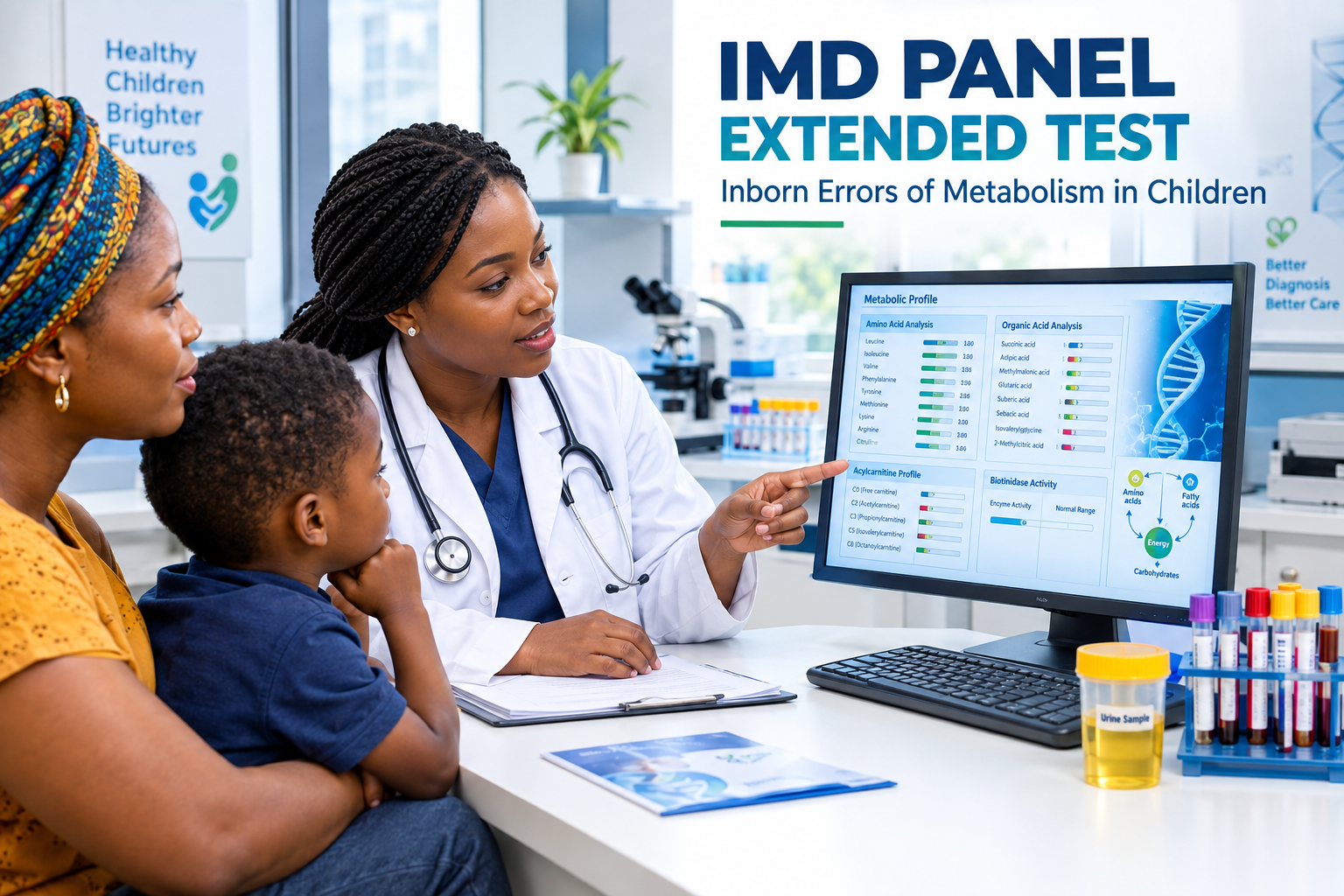
The IMD Panel Extended Test provides a broader metabolic assessment by combining several biochemical investigations, including amino-acid analysis, urine organic-acid analysis, acylcarnitine profiling and biotinidase activity. The purpose is not to diagnose every possible metabolic condition from one test, but to provide clinicians with biochemical information that can help guide further investigation.
What are inborn errors of metabolism?
Inborn errors of metabolism are inherited disorders caused by abnormalities in proteins—often enzymes, transporters or other components—that are involved in biochemical pathways.
A simplified way to understand metabolism is to think of it as a series of interconnected biochemical steps.
Food provides substances such as:
- Proteins and amino acids
- Fats and fatty acids
- Carbohydrates
- Vitamins and other nutrients
The body normally breaks these substances down, converts them into usable molecules and removes waste products.
When an inherited metabolic pathway is impaired, a substance may:
- Accumulate to abnormal levels.
- Fail to be converted into an essential product.
- Produce toxic metabolites.
- Interfere with cellular energy production.
The resulting biochemical disturbance can affect the brain, liver, muscles, kidneys and other organs.
WHO recognises metabolic disorders among congenital conditions and emphasises that some conditions may not become apparent until later infancy or childhood.
Why can metabolic disorders be difficult to recognise in Nigerian children?
Many inherited metabolic disorders do not have one distinctive symptom.
For example, a child with an underlying metabolic condition may initially present with:
- Poor feeding
- Vomiting
- Lethargy
- Failure to gain weight
- Seizures
- Developmental delay
- Muscle weakness
- Altered consciousness
- Recurrent unexplained illness
These symptoms have many possible causes.
In Nigeria, as elsewhere, clinicians may first need to consider more common infectious, nutritional, neurological, gastrointestinal or endocrine explanations. Metabolic disease may enter the differential diagnosis when symptoms are unusual, recurrent, severe, unexplained or associated with abnormal biochemical findings.
This makes clinical history extremely important.
The Nigerian context: why early detection matters
Nigeria has a large and diverse population and a substantial burden of childhood illness. At the same time, rare inherited disorders can be difficult to quantify because they require specialised diagnostic pathways.
It would therefore be inappropriate to assume that a rare metabolic disorder is either common or uncommon in Nigeria simply because published Nigerian prevalence data are limited.
What is clearer is the broader public-health principle: congenital conditions, including metabolic disorders, contribute significantly to childhood morbidity and mortality worldwide, with a disproportionate burden occurring in low- and middle-income countries.
WHO’s 2026 technical work on newborn screening further emphasises that early detection is valuable only when it connects children to appropriate confirmatory testing, treatment, follow-up and family support.
Recurrent unexplained vomiting
Vomiting is common in childhood. It becomes more diagnostically significant when it is recurrent, severe or associated with lethargy, dehydration, abnormal breathing, seizures, poor growth or biochemical abnormalities.
Some metabolic disorders can cause acute episodes following fasting, infection or increased metabolic stress.
Developmental delay or developmental regression
A child who is not meeting developmental milestones may require evaluation for many possible causes.
If a child who previously acquired skills begins to lose them, the situation warrants prompt medical assessment.
Metabolic, neurological, genetic and other conditions can contribute to developmental regression.
Recurrent seizures
Seizures in children have many causes, including structural, genetic, infectious, metabolic and unknown causes.
When seizures are accompanied by developmental problems, episodes of altered consciousness, unusual biochemical findings or recurrent unexplained illness, clinicians may consider metabolic investigations.
Poor feeding and failure to thrive
Persistent feeding difficulties or poor weight gain can arise from gastrointestinal, nutritional, endocrine, cardiac, neurological and other conditions.
An inherited metabolic disorder is one possible consideration when routine explanations do not adequately account for the child’s clinical picture.
Episodes triggered by illness or fasting
Some metabolic disorders become more apparent when the body is under stress.
Fever, infection, prolonged fasting or other physiological stress can increase energy requirements and expose an underlying metabolic vulnerability.
A pattern of repeated illness followed by unusual lethargy, vomiting, seizures, hypoglycaemia, acidosis or altered consciousness should be medically investigated
What does the IMD Panel Extended Test look for?
The value of an extended metabolic panel is that it examines several biochemical pathways rather than focusing on a single marker.
The key components include:
1. Amino-acid analysis
Amino acids are the basic components of proteins and participate in numerous metabolic pathways.
Abnormal amino-acid patterns can provide clues to disorders affecting amino-acid metabolism, including conditions involving the urea cycle or other pathways.
The pattern—not simply one elevated or reduced value—is important when interpreting these results.
2. Organic acids in urine
Organic acids are metabolic products that can accumulate or appear in abnormal patterns when particular biochemical pathways are disrupted.
Urine organic-acid analysis is an established investigation in the evaluation of suspected inborn errors of metabolism. The American College of Medical Genetics and Genomics describes organic-acid analysis as an important first-tier laboratory investigation for a broad range of IEMs, commonly performed using gas chromatography-mass spectrometry.
This can help identify biochemical patterns associated with disorders such as certain organic acidemias and other metabolic conditions.
Importantly, abnormal organic acids can sometimes arise from secondary causes, so results require appropriate clinical interpretation.
3. Acylcarnitine profile
Acylcarnitines are compounds associated with fatty-acid and energy metabolism.
An abnormal acylcarnitine pattern may provide clues to certain fatty-acid oxidation disorders and related metabolic abnormalities.
This is particularly relevant when a child’s symptoms appear during fasting or illness, when the body relies more heavily on alternative energy pathways.
4. Biotinidase activity
Biotinidase is involved in recycling biotin, a vitamin required for several carboxylase enzymes.
Reduced biotinidase activity can indicate biotinidase deficiency, an inherited metabolic condition for which effective treatment is available.
Because the clinical significance of an abnormal enzyme result depends on the specific laboratory method and degree of deficiency, appropriate interpretation and confirmation are important.
Why urine organic-acid testing is particularly useful
Urine contains metabolites that the body is eliminating.
When a metabolic pathway is disrupted, characteristic compounds can sometimes accumulate and subsequently appear in urine.
This makes urine organic-acid analysis valuable when clinicians suspect an organic acid disorder or another biochemical abnormality.
Research in paediatric populations has demonstrated that urinary organic-acid analysis can identify metabolic disorders that might otherwise be difficult to recognise clinically.
However, organic-acid results should never be interpreted in isolation.
Diet, illness, medications, nutritional status and other factors can influence metabolic profiles. A qualified clinician must interpret the pattern alongside the child’s clinical presentation.
When might a doctor consider metabolic testing?
Metabolic testing may be considered when the clinical presentation creates reasonable suspicion of an inherited metabolic disorder.
Potential situations include:
Acute metabolic-type illness
A previously well infant or child develops unexplained vomiting, lethargy, altered consciousness, seizures, hypoglycaemia, acidosis or other biochemical abnormalities.
Developmental concerns
A child has unexplained developmental delay, regression, intellectual disability or neurological abnormalities.
Recurrent unexplained episodes
A child repeatedly becomes severely ill without a clear underlying cause.
Family history
There is a previous unexplained infant death, known inherited metabolic disease or a family history that raises concern about an inherited condition.
Abnormal routine laboratory findings
Routine investigations may reveal abnormalities such as unexplained metabolic acidosis, hypoglycaemia, hyperammonaemia or abnormal liver-related findings.
What can trigger a metabolic crisis?
Some inherited metabolic disorders become more apparent during periods of physiological stress.
Potential triggers can include:
- Prolonged fasting
- Fever
- Infection
- Vomiting
- Dehydration
- Increased metabolic demand
Can metabolic disorders be detected in newborns?
Yes, some can.
Newborn screening programmes vary considerably between countries and health systems. Screening can include metabolic, endocrine and haematological conditions.
WHO notes that newborn screening can identify certain metabolic disorders that may not produce obvious symptoms immediately after birth.
Nigeria already has established newborn-care guidance addressing screening for conditions such as sickle cell disease and congenital hypothyroidism.
However, newborn screening and diagnostic metabolic evaluation are not identical.
A child who was not identified through newborn screening may still require metabolic evaluation later if concerning symptoms develop.
What Nigerian parents should know about family history
A family history can provide an important diagnostic clue.
Parents should tell their child’s doctor about:
- Previous unexplained infant deaths
- Children who died unexpectedly after becoming acutely ill
- Recurrent unexplained illness among siblings
- Known inherited metabolic conditions
- Consanguinity or parental relatedness, where relevant
- Unexplained developmental problems in relatives
Frequently Asked Questions
Can a child with normal routine blood tests still have a metabolic disorder?
Yes. Routine tests do not evaluate every metabolic pathway. When clinical suspicion remains, specialised biochemical investigations may be considered.
Does developmental delay always mean a child has a metabolic disorder?
Developmental delay has many possible causes. Metabolic disorders are one category among many that clinicians may consider.
Is the Organic Acids Urine Test the same as the IMD Panel Extended Test?
Urine organic-acid analysis is one component of broader metabolic evaluation. An extended IMD panel can incorporate several biochemical investigations. urine organic acid analysis is available in dnalabs Nigeria.
Does an abnormal metabolic test prove that a child has an inherited disease?
No. An abnormal finding generally requires clinical interpretation and, depending on the suspected condition, confirmatory biochemical, enzyme or genetic testing.
Can inherited metabolic disorders be treated?
Some can be managed effectively, particularly when identified early. Treatment varies significantly according to the specific disorder and may include dietary management, vitamins or cofactors, medications, enzyme replacement or other specialist interventions.
Final Takeaway for Nigerian Families
Inborn errors of metabolism are rare individually, but they can have serious consequences when they are not recognised.
For Nigerian children with unexplained recurrent illness, developmental delay, seizures, poor growth, unusual biochemical findings or episodes triggered by illness or fasting, an inherited metabolic disorder may be one of the conditions a clinician considers.
The IMD Panel Extended Test brings together several complementary biochemical investigations, including amino acids, urine organic acids, acylcarnitines and biotinidase activity.It should not be viewed as a stand-alone answer to every unexplained childhood symptom. Rather, it is one part of a diagnostic pathway that combines clinical assessment, biochemical testing and, where appropriate, confirmatory genetic or enzyme studies.
For more information about the investigation, see the DNA Labs Nigeria IMD Panel Extended Test page: