
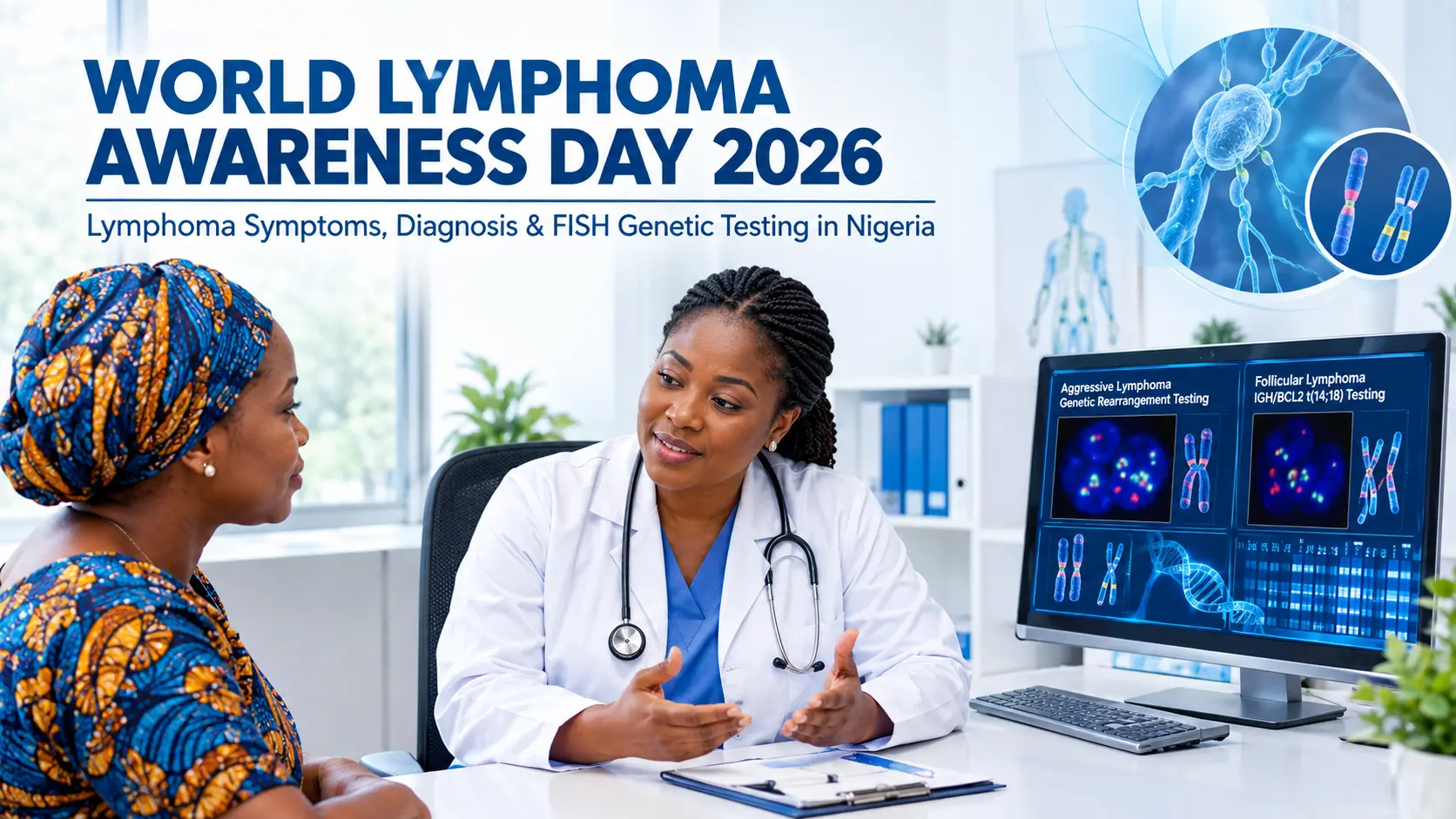
Every year on September 15, World Lymphoma Awareness Day helps people learn about lymphoma, its warning signs, and the importance of early medical care.
For Nigerians, knowing the symptoms of lymphoma can help people seek medical advice when something does not feel right. A swollen lymph node, ongoing fever, or unexplained weight loss may have many causes. However, these symptoms should not be ignored when they persist.
This article explains lymphoma in simple terms and shows how FISH genetic testing can help doctors understand certain types of lymphoma.
What Is Lymphoma?
Lymphoma is a type of cancer that affects the lymphatic system. This system helps the body fight infections and remove unwanted waste.
Lymphoma begins when certain white blood cells, called lymphocytes, start growing abnormally. These cells may collect in the lymph nodes or other parts of the body.
1. Hodgkin lymphoma
Hodgkin lymphoma is a cancer of the lymphatic system with specific abnormal cells that doctors can identify during laboratory examination.
2. Non-Hodgkin lymphoma
Non-Hodgkin lymphoma includes many different types of lymphoma. Some grow slowly, while others grow quickly and are called aggressive lymphomas.
Examples include:
- Diffuse large B-cell lymphoma (DLBCL).
- Follicular lymphoma.
- Burkitt lymphoma.
- Mantle cell lymphoma.
Each type may need a different approach to diagnosis and treatment.
Why Is Lymphoma Awareness Important in Nigeria?
Some lymphoma symptoms look similar to common infections and other illnesses in Nigeria.
For example, swollen lymph nodes may happen because of an infection. But if a swelling continues to grow or does not go away, it should be checked by a doctor.
Awareness can help Nigerians recognise possible warning signs and seek medical care early. It also helps patients understand why doctors may request special laboratory tests.
What Are the Warning Signs of Lymphoma?
Lymphoma can cause different symptoms depending on the type and where it develops.
Common warning signs include:
1. Swollen lymph nodes
A painless lump in the neck, armpit, or groin may be an enlarged lymph node. Many swollen nodes are caused by infections, but persistent or unexplained swelling needs medical assessment.
2. Unexplained fever
A fever that keeps coming back without a clear reason should be discussed with a doctor.
3. Night sweats
Some people with lymphoma experience heavy night sweats that soak their clothes or bedding.
4. Unexplained weight loss
Losing weight without trying may be a warning sign, especially when it occurs with other symptoms.
5. Persistent tiredness
Lymphoma may cause unusual tiredness. However, fatigue can also result from anaemia, infections, poor sleep, and other conditions.
6. Other possible symptoms
Depending on where the lymphoma develops, a person may experience:
- Persistent cough or chest discomfort.
- Abdominal swelling or discomfort.
- Feeling full after eating only a small amount.
- Itching.
- Repeated infections.
What Are the Main Types of Lymphoma?
Lymphoma is not one single disease. Different types behave differently in the body.
Aggressive lymphoma
Aggressive lymphoma can grow quickly. Some high-grade B-cell lymphomas have genetic changes involving genes such as MYC, BCL2, and BCL6.
Finding these changes may help doctors understand and classify the lymphoma more accurately.
Follicular lymphoma
Follicular lymphoma is a type of non-Hodgkin lymphoma that often grows slowly.
It develops from B cells, which are part of the immune system. In some cases, follicular lymphoma can change into a faster-growing form of lymphoma.
Many cases of follicular lymphoma are linked to a genetic change called IGH/BCL2 t(14;18). Doctors may request a special test to look for this change.
How Is Lymphoma Diagnosed?
Doctors use several tests to find out whether a person has lymphoma and which type it is.
Medical examination
The doctor asks about symptoms and checks for swollen lymph nodes or other changes.
Blood tests
Blood tests can show changes in blood cells and help assess a person’s general health. However, blood tests alone usually cannot confirm lymphoma.
Scans
Ultrasound, CT scans, or other imaging tests may help doctors find enlarged lymph nodes and see where the disease may be present.
Biopsy
A biopsy is one of the most important tests for diagnosing lymphoma.
During a biopsy, a doctor removes a small piece of tissue or an entire lymph node. A pathologist examines the sample under a microscope to look for cancer cells.
Special laboratory tests
Doctors may also request immunohistochemistry, flow cytometry, or genetic tests. These tests help identify the exact type of lymphoma.
What Is FISH Genetic Testing?
FISH means fluorescence in situ hybridisation.
It is a laboratory test that looks for specific genetic changes inside cells. These changes may help doctors understand certain types of lymphoma.
FISH uses special DNA probes that attach to selected genetic regions. Under a fluorescence microscope, laboratory specialists examine the signals to see whether a particular genetic rearrangement is present.
In simple terms, FISH helps doctors look for specific changes in the DNA of the cells being tested.
Why Is FISH Testing Used for Lymphoma?
Different types of lymphoma can look similar. Genetic testing may help doctors tell them apart.
FISH may be recommended when a doctor or pathologist suspects a lymphoma with a particular genetic change.
FISH testing for aggressive lymphoma
Some aggressive B-cell lymphomas have changes involving the MYC, BCL2, or BCL6 genes.
An aggressive lymphoma FISH panel may look for selected rearrangements involving these genes. The findings can help specialists classify the disease more accurately.
Learn more about the Aggressive Lymphoma FISH Panel Test.
FISH testing for follicular lymphoma
Many follicular lymphomas have a genetic rearrangement called IGH/BCL2 t(14;18).
This rearrangement involves the IGH region and the BCL2 gene. It is associated with the development of many follicular lymphomas.
An IGH/BCL2 FISH test can help doctors investigate this genetic change when follicular lymphoma is suspected.
Learn more about the Follicular Lymphoma IGH/BCL2 t(14;18) FISH Test.
What Do FISH Test Results Mean?
A FISH report may show that a particular genetic rearrangement was detected or not detected.
Positive result
A positive result means that the genetic change being tested was found in the sample.
This can provide useful information for lymphoma diagnosis. However, it does not replace the biopsy or other tests.
Negative result
A negative result means that the specific genetic change tested was not found.
It does not always mean that the person does not have lymphoma. Another genetic change may be present.
Why is specialist interpretation important?
FISH results must be interpreted together with the biopsy, other laboratory tests, and the patient’s symptoms.
A haematologist, oncologist, or pathologist can explain what the result means for the individual patient.
What Should Nigerians Know About Lymphoma Testing?
If a person has persistent swollen lymph nodes, unexplained fever, night sweats, or weight loss, they should seek medical advice.
Patients diagnosed with lymphoma can ask their doctor:
- What type of lymphoma do I have?
- Is it aggressive or slow-growing?
- Do I need a biopsy or additional laboratory tests?
- Would FISH testing help confirm the lymphoma subtype?
- How will the test results help my healthcare team?
Frequently Asked Questions
1. What is World Lymphoma Awareness Day?
World Lymphoma Awareness Day is observed every year on September 15. It helps raise awareness about lymphoma, its symptoms, diagnosis, and treatment.
2. Does every swollen lymph node mean cancer?
Swollen lymph nodes are often caused by infections. However, a lump that persists, grows, or has no clear cause should be checked by a doctor.
3. What is the difference between aggressive and follicular lymphoma?
Aggressive lymphoma usually grows quickly. Follicular lymphoma often grows more slowly, although it can sometimes become aggressive.
4. Why is FISH testing used for aggressive lymphoma?
FISH may identify selected genetic rearrangements involving genes such as MYC, BCL2, and BCL6. These findings can help doctors classify certain aggressive B-cell lymphomas.
5. What is the IGH/BCL2 t(14;18) test?
It is a targeted FISH test that looks for a specific genetic rearrangement associated with many cases of follicular lymphoma.
6. Can FISH testing replace a biopsy?
Usually, no. A biopsy and other laboratory tests are important for diagnosing and classifying lymphoma. FISH provides additional genetic information.
7. Does a negative FISH result rule out lymphoma?
No. A negative result only means that the particular genetic change tested was not detected. Other tests may still be needed.
8. What should I do if I notice possible lymphoma symptoms?
Speak with a qualified healthcare professional. The doctor can investigate the symptoms and recommend the appropriate tests.
Conclusion
World Lymphoma Awareness Day 2026 reminds Nigerians that understanding cancer symptoms and seeking medical advice are important steps towards better health.