
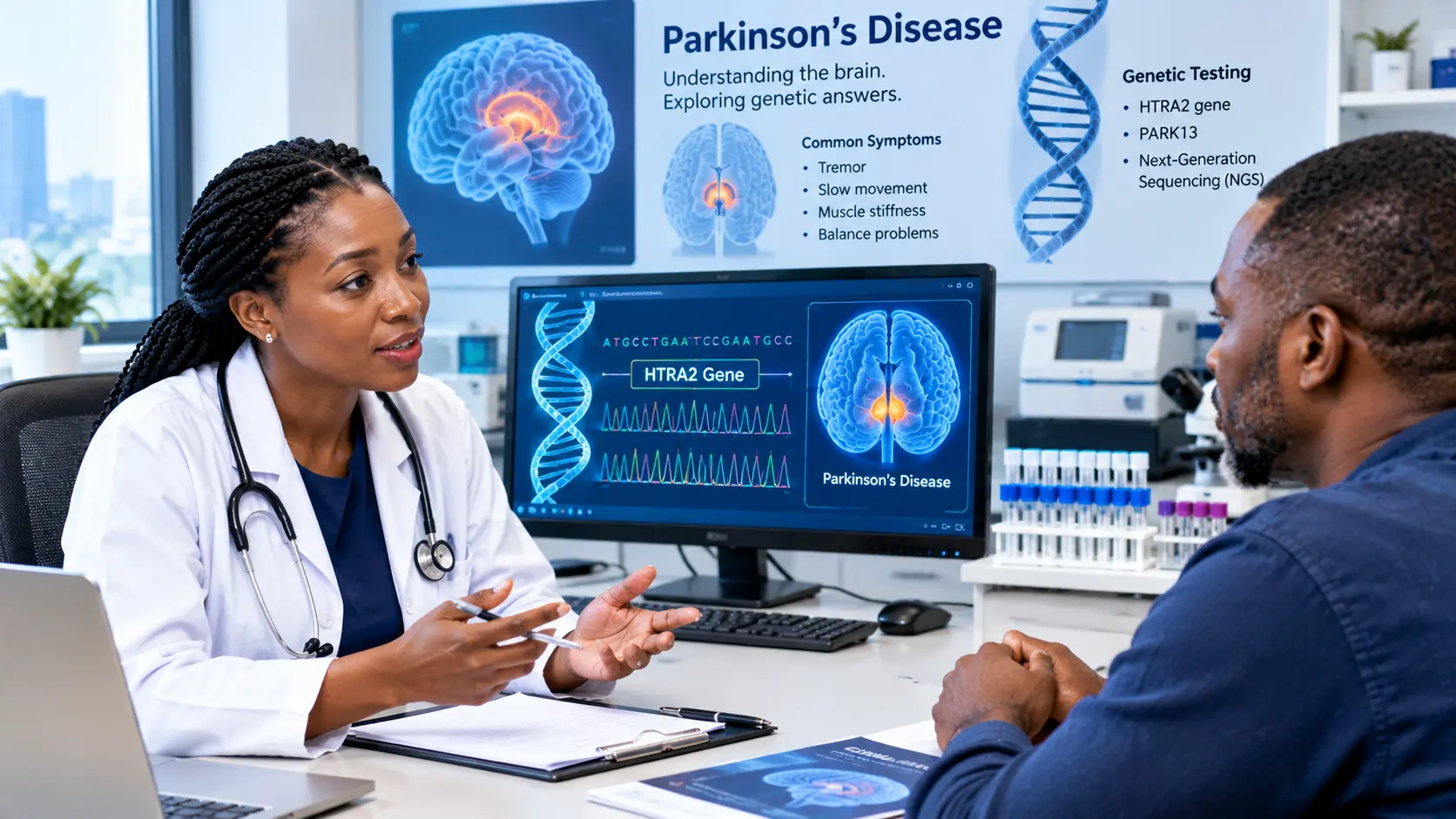
Parkinson’s Disease in Nigeria:
Parkinson’s disease is a progressive neurological disorder. It happens when certain nerve cells in the brain become damaged or are lost over time.
These cells are involved in producing dopamine, a chemical that helps the brain control movement.
As dopamine-producing cells are affected, a person may develop symptoms such as shaking, stiffness, slower movements and difficulty with walking or balance. Parkinson’s can also cause non-movement symptoms, including sleep problems, pain, depression and changes in thinking.
Is Parkinson’s Disease Genetic?
Sometimes, genetics can contribute to Parkinson’s disease.
Researchers have identified several genes associated with Parkinson’s disease. These include genes such as LRRK2, SNCA, PRKN, PINK1 and PARK7.
Other genes have been investigated because they may influence Parkinson’s risk or particular forms of parkinsonism.
HTRA2 Affecting Cells:
The HTRA2 protein is involved in mitochondrial quality control and cellular stress responses.
Think of mitochondria as small energy-producing units inside cells. Brain cells need a continuous supply of energy to function properly.
Researchers have therefore investigated whether changes affecting mitochondrial proteins such as HTRA2 could make nerve cells more vulnerable to stress.
This is one reason HTRA2 remains scientifically interesting in Parkinson’s disease research, even though its exact contribution to human Parkinson’s disease remains uncertain.
Genetic Testing for Parkinson’s Disease:
Genetic testing examines a person’s DNA for specific genetic changes or variants.
Depending on the clinical question, testing may focus on one gene or examine several genes using technologies such as Next-Generation Sequencing (NGS).
NGS allows laboratories to read many sections of DNA at the same time.
In simple terms, imagine DNA as a very large instruction manual. Genetic testing looks for differences in the spelling of that instruction manual that may be medically relevant.
Who May Need Genetic Testing?
Genetic testing may be considered when Parkinson’s disease occurs at a younger age or when several family members have similar conditions.
A doctor may also recommend testing when the symptoms or family history suggest a possible inherited form of Parkinsonism.
Parkinson’s Disease and Genetics in Nigeria
Parkinson’s disease is an important neurological condition in Nigeria.
Research suggests that Parkinson’s disease may be underdiagnosed in the country.
More research involving African populations can help scientists better understand how genetic factors may contribute to Parkinson’s disease.
FAQS:
1. What is PARK13?
PARK13 is a name historically associated with the HTRA2 gene and Parkinson’s disease research.
Scientists have investigated whether certain HTRA2 variants may contribute to Parkinson’s disease.
2. What is the HTRA2 gene?
The HTRA2 gene contains instructions for making a protein involved in mitochondrial function and cellular processes.
Researchers have studied this gene because of its possible connection with Parkinson’s disease.
3. Who may benefit from genetic testing for Parkinson’s disease?
Genetic testing may be considered for people with young-onset Parkinsonism, a strong family history, or other features suggesting a possible inherited condition.
A doctor or genetic counsellor can help determine whether testing is appropriate.
4. What does NGS mean in genetic testing?
NGS stands for Next-Generation Sequencing.
It is a modern technology that allows laboratories to examine many sections of DNA and identify genetic variants.
5. Can Parkinson’s disease run in families?
Yes, Parkinson’s disease can sometimes occur in families.
However, having a relative with Parkinson’s does not necessarily mean that you will develop the condition.